


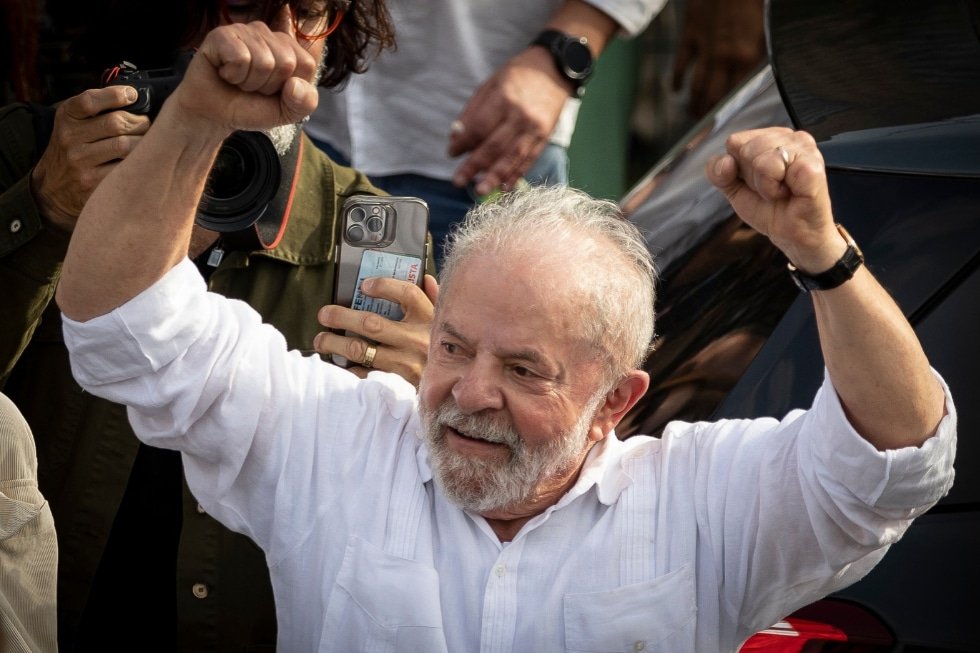



Luiz Inácio Lula da Silva has once again rewritten Brazil’s electoral history. At 80, the historic leader of the Workers’ Party (PT) has become the first Brazilian president to win four presidential elections. His October 25 victory was also unprecedented: Since Brazil’s return to democracy, no presidential candidate who finished second in the first round has won the runoff.
Three weeks earlier, Senator Flávio Bolsonaro, representing the Liberal Party (PL), had finished ahead of Lula by nearly two percentage points. Opinion polls and financial markets subsequently anticipated a highly competitive runoff, with expectations increasingly favoring Bolsonaro. Yet Lula staged a remarkable comeback, winning 51.79% of valid votes against Flávio’s 48.21%. His 4.43 million-vote margin was substantially larger than the approximately 2.14 million votes by which he defeated Former President Jair Bolsonaro in 2022.
The result raises two relevant questions for Brazilian politics. How did Lula reverse an electoral disadvantage that few anticipated he could overcome? And what does his victory mean for a country whose congressional and gubernatorial elections had simultaneously shifted its political balance further to the right?
The anatomy of an electoral comeback
Lula’s comeback was remarkable for its magnitude and geographical breadth. Between the two rounds, his vote total increased by 10.38 million, compared with 3.72 million for Flávio Bolsonaro. Nearly half of Lula’s additional votes in the runoff came from the Southeast, the most populous region and where he had lost the first round. In Minas Gerais — the country’s second-largest electoral state and a historical bellwether of presidential outcomes — he reversed the first-round result. His substantial gains across this state were critical to his national victory.
Altogether, Lula won the runoff in 2,874 of Brazil’s 5,571 municipalities, and his vote-gain between the two rounds exceeded Flávio’s in 5,228 municipalities. This demonstrates that his electoral recovery extended well beyond the Workers’ Party’s traditional strongholds in the Northeast, including many municipalities where Flávio ultimately remained ahead.
Voting patterns suggest both candidates retained about 98% of their first-round supporters. The difference lay in attracting voters beyond their original electoral bases. Lula appears to have won over a substantial majority of voters who had previously cast blank or invalid ballots. Perhaps more surprisingly, he also attracted most voters from eliminated presidential candidates who subsequently supported a finalist, despite the predominantly conservative orientation of several of those candidates.
The turnaround also reflected a change in campaign strategy. After his disappointing first-round performance, Lula shifted his emphasis to immediate socioeconomic concerns, including wages, pensions, social protection and working hours. His supporters simultaneously intensified street mobilization and digital campaigning, including a large WhatsApp network coordinated by Congressman André Janones. Although the precise electoral effects of these initiatives cannot be isolated, they formed part of a broader effort to mobilize previously disengaged voters and expand Lula’s electoral appeal.
Lula also benefited from legislative developments during the runoff campaign. With cooperation from congressional leaders outside the left, the Senate approved a bill reducing the standard workweek from 44 to 40 hours and guaranteeing two weekly rest days. Beyond its immediate electoral significance, the measure illustrated the possibility of building cross-party agreements on social policy — an ability that will be essential for governing a more conservative Congress.
The final televised debate also revealed contrasting campaign strategies. According to an analysis by DecideBrasil, Lula devoted 38% of his speaking time to defending his government’s record and presented just eight promises, while Flávio Bolsonaro made 50. Lula also repeatedly invoked the political legacy of Jair Bolsonaro rather than confronting his son exclusively on policy proposals. This combination of retrospective economic appeals and criticism of Bolsonarism may have helped Lula reach voters beyond his traditional left-wing base, although the debate data alone cannot establish its electoral impact.
Lula’s comeback was more than a triumph of traditional left-wing mobilization. It also depended on attracting voters beyond his original coalition and demonstrating that political cooperation remained possible across ideological divisions. His victory reveals both the resilience of Brazil’s left and the challenges of governing a country whose political institutions have moved considerably to the right.
A victory amid electoral controversies
The runoff was also marked by disputes over digital campaigning and vote administration.
During October, Lula’s campaign accused Meta — the parent company of Facebook, Instagram and WhatsApp — of restricting the distribution of its political content and treating the two presidential campaigns unequally. Brazil’s Superior Electoral Court (TSE) ordered the company to provide technical explanations about content moderation, algorithmic distribution and artificial intelligence. Meta denied deliberately favoring either candidate, attributing the incidents to technical problems and shortcomings in its systems.
The dispute illustrates a broader democratic challenge: Digital platforms have become central infrastructures of electoral competition, yet candidates, regulators and citizens still struggle to scrutinize the mechanisms that determine political visibility.
An even more contentious episode occurred on election day. Following reports of transportation disruptions and severe weather affecting voters, a Supreme Court justice extended voting hours by two hours. Both presidential campaigns requested the decision, but its late announcement created confusion because some polling stations had already closed.
Flávio Bolsonaro subsequently challenged the legitimacy of the result and announced his intention to seek its annulment. Yet the number of votes cast after the original closing time was only a tiny fraction (around 34,300 votes) of Lula’s 4.43-million-vote margin. Electoral authorities maintained that the extension did not alter the outcome.
The controversy nevertheless reopened a familiar political conflict. Following Jair Bolsonaro’s defeat in 2022, attacks on the electoral system escalated into efforts to overturn the democratic transfer of power, culminating in the events of January 8, 2023, when supporters invaded Brazil’s principal democratic institutions. Jair Bolsonaro was subsequently convicted for his role in an attempted coup.
The comparison does not mean that the present situation will follow the same trajectory. It does, however, demonstrate why acceptance of electoral defeat remains a central question for Brazilian democracy.
The Bolsonarist camp has not responded uniformly to Lula’s victory. While Flávio Bolsonaro initially contested the result, his own Liberal Party formally recognized Lula’s reelection. The divisions have become more consequential following Flávio’s departure for the United States on October 27, just two days after the runoff. He left Brazil despite a Supreme Court order prohibiting international travel and requiring him to surrender his passports. The order was issued in connection with an investigation into suspected money laundering.
Flávio has described the investigation as politically motivated, an allegation for which he has not presented substantiated evidence. In his first public appearance on US soil, in Washington, DC, he referred to himself as the “true elected president of Brazil.” The episode creates a diplomatic dilemma for Washington, particularly as Lula has accused the Trump administration of interfering in Brazil’s electoral process, an allegation the White House denies.
Flávio’s departure has also introduced an international dimension to Brazil’s post-election tensions. The Trump administration has confirmed that it will issue visas to him and his family, raising questions about Washington’s potential involvement in a dispute between the Bolsonaro family and Brazil’s judiciary.
His campaign had also promised amnesty for Jair Bolsonaro and allies convicted in connection with the attempted coup. Lula’s victory removes the prospect of a Bolsonaro presidency advancing that agenda, but the family’s confrontation with judicial institutions continues. Meanwhile, conservative leaders who accepted the election result face the challenge of defining a political future that may no longer depend exclusively on the Bolsonaro family.
A left-wing president in a more conservative Brazil
Lula’s victory does not reverse the broader electoral transformation that occurred on October 4.
The PL emerged as the largest party in both houses of Congress, winning 121 seats in the Chamber of Deputies and securing a projected total of 28 senators. Right and center-right candidates also performed strongly in gubernatorial elections, consolidating conservative political influence across much of the South, Southeast and Center-West.
This creates an unusual political configuration in which a left-wing president with a strong personal mandate faces a considerably more conservative legislative environment. The challenge will be particularly acute in economic policy. Lula has promised to preserve and expand social protection while gradually adjusting public finances. Delivering on those commitments will require agreements with centrist and center-right parties, particularly on taxation, public expenditure and fiscal rules.
The financial markets’ reaction to his victory revealed the magnitude of the challenge. On October 26, the Ibovespa (the main stock market performance indicator on B3 and a major index of Brazil’s capital market) fell sharply, triggering a temporary trading suspension. The index lost nearly 14% by the close, after falling more than 17% at its lowest point during the session. The Brazilian real also depreciated significantly. The selloff reflected investors’ reassessment of fiscal and economic policy expectations following a result that contradicted their prevailing assumptions.
Market uncertainty is compounded by a fragmented congressional landscape in which centrist and conservative parties differ substantially in their economic priorities, regional interests and relationships with the presidency. Lula’s ability to govern will depend on his capacity to construct legislative coalitions, an increasingly difficult task.
That is a familiar challenge for a politician whose earlier presidency was built around pragmatic alliances extending well beyond the left. The difference is that the political right now possesses a stronger electoral organization, greater representation in the Senate and a more consolidated political identity.
The paradox of Brazil’s 2026 elections
Lula’s presidential victory coincided with a conservative advance in Congress and state governments, illustrating how different electoral contests can produce divergent outcomes, particularly when a presidential runoff presents voters with a binary choice between two highly polarizing candidates.
These results reveal the coexistence of competing political forces: a resilient left capable of national mobilization, an increasingly institutionalized right and a political center whose legislative support remains indispensable. Despite Lula’s remarkable political resilience, his next administration will confront institutional fragmentation, economic uncertainty and a polarized electorate. Governing under these conditions will require accommodating competing political preferences, potentially creating opportunities to reduce polarization.
This will be Lula’s final presidential term. His most important legacy may depend on whether he can use this unexpected victory to reduce political hostility, rebuild confidence in democratic institutions and reconcile social inclusion with economic stability. Lula has won the presidency, but the more difficult task will be governing a Brazil that has moved to the right.
[Kaitlyn Diana edited this piece.]
The views expressed in this article are the author’s own and do not necessarily reflect Fair Observer’s editorial policy.
Brazil’s 2026 Elections: The Right Advances and Bolsonarism Endures
Brazil’s 2026 elections delivered more than an unexpected first-round lead for Senator Flávio Bolsonaro. Gains by the right across Congress...
Brazil Is the Country of the Devil — and God Knows Who the “Believers” Are
Brazil’s first-round election results illustrate how many citizens choose their politician not based on who’s best for the country, but...
Trump’s Latin American Solar System: Will Brazil Orbit That System?
While US President Donald Trump’s global popularity collapses, his “Donroe Doctrine” thrives in Latin America. This regional success stems from...
Brazilian 2026 Election: Lula’s Soft Power Skills Threatened by a Hard-Power World
Brazil’s October election matches the polarized 2022 election, with incumbent Brazilian President Lula da Silva polling ahead of Senator Flávio...

Support Fair Observer
We rely on your support for our independence, diversity and quality.
For more than 10 years, Fair Observer has been free, fair and independent. No billionaire owns us, no advertisers control us. We are a reader-supported nonprofit. Unlike many other publications, we keep our content free for readers regardless of where they live or whether they can afford to pay. We have no paywalls and no ads.
In the post-truth era of fake news, echo chambers and filter bubbles, we publish a plurality of perspectives from around the world. Anyone can publish with us, but everyone goes through a rigorous editorial process. So, you get fact-checked, well-reasoned content instead of noise.
We publish 3,000+ voices from 90+ countries. We also conduct education and training programs
on subjects ranging from digital media and journalism to writing and critical thinking. This
doesn’t come cheap. Servers, editors, trainers and web developers cost
money.
Please consider supporting us on a regular basis as a recurring donor or a
sustaining member.
Will you support FO’s journalism?
We rely on your support for our independence, diversity and quality.




Comment