

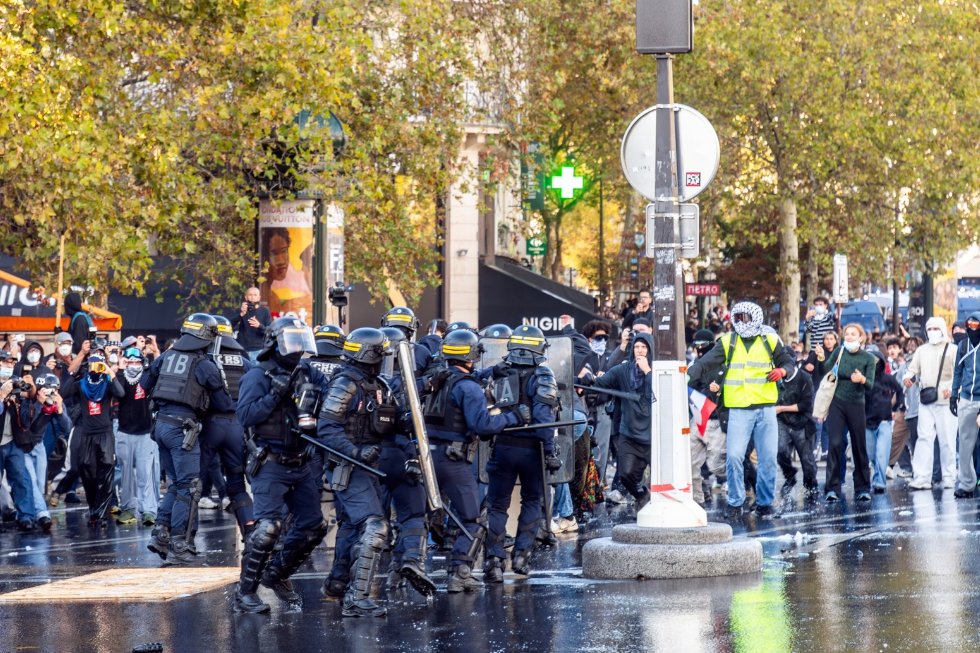



On November 12, Spain’s interior minister, Fernando Grande-Marlaska, ordered the National Police to investigate how its officers had dispersed demonstrators during a general strike over housing costs and wages the previous day. He questioned the proportionality of some interventions and told the force to stop using tear gas at demonstrations. In Madrid, police charged groups that included people behaving peacefully. Grande-Marlaska assigned the investigation to the leadership of the force whose conduct he had questioned.
The Spanish strike was part of a wider autumn of social unrest. In France, protests over school funding broadened into demonstrations over wages and the cost of living. In Italy, student mobilizations and protests over living costs and low pay brought people into the streets, including in Turin and Bologna. In Portugal, housing costs helped drive protests. The government response in France and Spain shows what happens when governments answer these disputes with powers that take effect immediately and safeguards that work only after the damage is done.
Who pays when Europe gets protest policing wrong? Peaceful demonstrators pay first, through injuries, arrests or a missed chance to march. The public pays at the next protest. When police tactics drive peaceful participants away, officials risk losing the contacts they need to understand what is happening and intervene before violence spreads.
Who bears the cost of a wrong decision?
In September, French high school students began protesting conditions in schools, including inadequate staffing and resources. The demands widened as unions mobilized around wages and the cost of living. On October 17, rioting in several cities caught security forces off guard. The French Interior Ministry subsequently turned counterterrorism powers on activists whose plans to attend demonstrations were already visible to the authorities.
The ministry used individual administrative control and surveillance measures to restrict activists’ movements during the protests. These measures, known in France as MICAS, can confine someone to a defined area or require them to report to the police. The domestic security code reserves them for preventing terrorism and requires a serious threat with a specified connection to terrorist activity or ideology.
In one case, a farmer who had taken part in earlier demonstrations challenged an order that kept him from joining a march. The administrative court in Poitiers overturned it at 7 PM. By then, he had missed the march. The French Interior Ministry obtained its order immediately. The farmer had to challenge it in court and still lost the opportunity to demonstrate. The French Interior Ministry can impose the same burden on other activists at the next protest. Each person has to find a lawyer and secure a ruling before the march begins.
The policing of high school protests created another grievance. Human Rights Watch documented excessive force against students. Amnesty International reported that a 15-year-old lost a hand when a grenade exploded during a school protest in Lens on October 5. At 6 PM on November 5, the French Interior Ministry’s preliminary tally recorded 448 arrests, 53 injuries to security personnel and 86 responses to fires. The release gave no comparable count of injuries to demonstrators. Without that figure, the public had no way to tell from the ministry’s account how many demonstrators were hurt or how much harm the police intervention may have caused.
Spain’s inquiry should start with the orders
On November 12, the standing committee of Spain’s lower house, which acts while parliament is dissolved ahead of an election, voted 35–34 to preserve limits on some rent increases and protections against eviction for vulnerable tenants.
The committee rejected a separate decree that would have made leases automatically renewable at tenants’ request. Both measures had been contested before the strike. The police operation left the government with two disputes. Tenants still wanted an answer on leases. People who had marched now also wanted an explanation for how the police had treated them.
The Spanish Interior Ministry said its investigation would be separate from the National Police’s routine internal inspection. Grande-Marlaska nevertheless assigned it to the leadership of the same force whose conduct was in question. The inquiry’s value will depend on whether it can identify who authorized the charges, establish what those officials knew and make the findings public. Suspending tear gas can change how officers disperse a crowd. It cannot explain why they were told to disperse it or establish who should answer for injuries.
The next protest will be harder to read
Amnesty International’s review of 21 countries documented recurring restrictions on peaceful assembly before this autumn. The French and Spanish cases show why that record matters for public safety. Student groups, unions and tenant organizations can explain a grievance, tell officials where negotiations are breaking down and speak for people who intend to march peacefully. When demonstrators face injury, arrest or exclusion, some may stay home. If the organizations that represent them also lose members or stop speaking with officials, authorities will have fewer trusted contacts when tensions rise again.
That is how a smaller demonstration can leave a government with a bigger problem. If turnout falls while the grievances persist and organizers withdraw from talks, officials may mistake silence for a settlement. When people mobilize again, the authorities will have less reliable information about who is taking part and less time to respond if violence breaks out. They may then fall back on broad restrictions and indiscriminate dispersal, repeating the decisions that damaged those relationships in the first place.
France can show whether a court can review a restriction in time for someone to attend a march and whether the Interior Ministry will account for injuries to protesters as promptly as injuries to officers. Spain can show whether the investigation reaches the people who gave the orders and whether it makes its findings public. In both countries, continued talks with student, labor and housing groups would tell us more about whether the crisis is easing than the number of arrests at the next march.
Europe’s double standard will come at a cost. The European Union makes human rights and the rule of law central to its foreign policy. At home, France used counterterrorism powers to keep activists from marching, and Spain asked the police to investigate their own use of force.
The first to pay are the people injured or shut out of public life. The danger for everyone else is that the next surge of anger will arrive after governments have weakened the groups that can bring people to the negotiating table. With rents still high and public services under strain, the quiet between protests may be the last chance to hear them.
[Kaitlyn Diana edited this piece.]
The views expressed in this article are the author’s own and do not necessarily reflect Fair Observer’s editorial policy.
France Erupts in Mass Protests Yet Again
In the October 2026 episode of FO Exclusive, Atul Singh and Glenn Carle examine how French protests and mounting debt...
India’s Cockroach Generation: A Youth Movement Challenges the Establishment
The Cockroach Janta Party (CJP) has emerged in India as a youth-led political movement, transforming the cockroach into a symbol...
Blood on the Streets: Indonesia Silences Its People’s Pleas
Indonesian protesters took to the streets last week to demand government accountability, fair wages and an end to corruption. During...
Support Fair Observer
We rely on your support for our independence, diversity and quality.
For more than 10 years, Fair Observer has been free, fair and independent. No billionaire owns us, no advertisers control us. We are a reader-supported nonprofit. Unlike many other publications, we keep our content free for readers regardless of where they live or whether they can afford to pay. We have no paywalls and no ads.
In the post-truth era of fake news, echo chambers and filter bubbles, we publish a plurality of perspectives from around the world. Anyone can publish with us, but everyone goes through a rigorous editorial process. So, you get fact-checked, well-reasoned content instead of noise.
We publish 3,000+ voices from 90+ countries. We also conduct education and training programs
on subjects ranging from digital media and journalism to writing and critical thinking. This
doesn’t come cheap. Servers, editors, trainers and web developers cost
money.
Please consider supporting us on a regular basis as a recurring donor or a
sustaining member.
Will you support FO’s journalism?
We rely on your support for our independence, diversity and quality.




Comment