




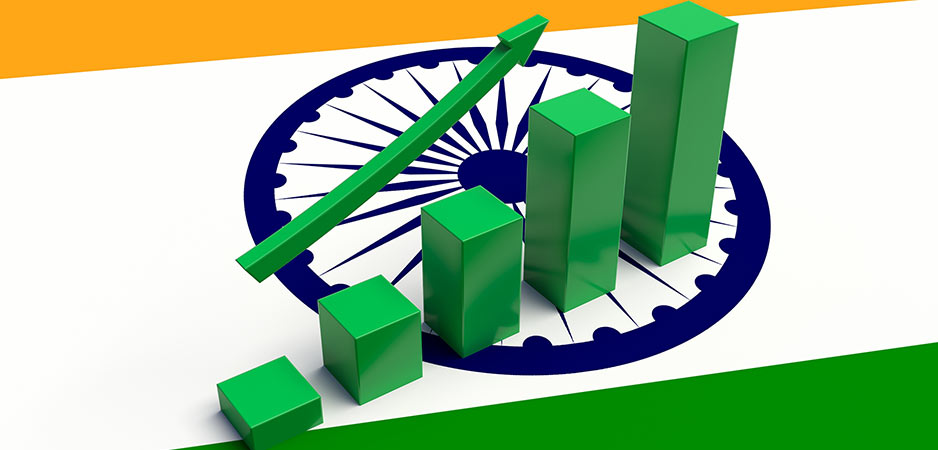
India is now consistently growing at around 7% per annum. It is the fastest-growing large economy in the world. Currently, its GDP is ranked fifth in the world. In 18 months, experts estimate that India will overtake Germany to become the fourth-largest economy and, in 2028, it will go past Japan to occupy the third position after the US and China. By then, India will be a $5 trillion economy.
Even as India grows at a fast clip, the government is achieving great success in poverty reduction. In fact, one of the biggest, if not the biggest, instances of poverty reduction ever is underway. Indians are better fed, living longer, growing taller and doing better than ever.
Fundamentals of growth
India is growing strongly because of strong fundamentals. The services sector is doing well. India is now the back-office office of the world. Its services exports are rising. Domestic demand for services is growing strongly, too. India now has over 100 unicorns (startups valued at over $1 billion) this number is only likely to grow. Tourism has rebounded sharply after Covid and it is largely thanks to Indian, not foreign, tourists.
The Purchasing Managers’ Index (PMI) is red-hot at 57.7 in July. The PMI measures the performance of the manufacturing sector, and a score above 50 indicates a positive development. In the past, India skipped the manufacturing stage. Indira Gandhi’s leftward lurch and the Janata Party experiment imposed socialism that bound the economy in red tape and led to the so-called Hindu rate of growth.
The current government is addressing legacy issues by building infrastructure at record speed and addressing red tape issues. Airports, roads, ports and now railways are coming up. This economic activity boosts the GDP and builds assets for the future. As in the case of the US in the 1950s and China in the 1980s, this infrastructure building program is resulting in a multiplier effect for the economy.

Growth has also increased because India is finally an economic union, not just a political union. In 2017, the government introduced the goods and sales tax (GST) across the country, making India an economic union. Before GST, businesses had to pay all sorts of taxes and tariffs to state governments and the national government. Exporting from one part of the country to another was arduous. This socialist command and control system was a millstone around the neck for the economy. Now, this Soviet legacy is gone, giving the economy a great boost.
In 1991, India liberalized just as the Soviet Union was tottering and the Gulf War sent oil prices spiraling. Entry barriers for businesses came down and the economy boomed. However, exit barriers remained, creating zombie companies and hurting banks. From 2006 to 2014, India’s banks went on a lending binge. As a result, they were in poor shape with huge amounts of bad debt on their books.
In 2016, the government instituted the Insolvency and Bankruptcy Code (IBC). The goal was to clean up the banks. The IBC instituted a brand new system that turned out to be spectacularly successful. Now, creditors could finally enforce their rights. It turned out that only 50 companies comprised two-thirds of the problem. Of these, a third—the dirty dozen—comprised a third of the whole economy’s problem. Banks were able to claim assets from these companies, and money came back even from supposedly bankrupt companies for this reason. As a result, banks are a lot healthier today.
India’s innovative Covid economic policy
While advanced economies like the US, the UK, Germany and others saw Covid as a demand-side shock. In response, these governments distributed stimulus checks. The Indian government, on the other hand, saw Covid as a supply-side shock. People still wanted to spend money but they could not do so because of government restrictions. Lockdowns, restrictions on public gatherings and the fear of coronavirus were really supply-side issues.
When businesses like bars and restaurants did not get cash from customers, this meant they could not pay their employees, suppliers or landlords. Hence, the economy experienced a payments problem that cascaded from one business to another, causing a defaults problem. The government saw this as a cash flow problem and moved to support small and medium-sized enterprises (SMEs). This support was a safety net, not an inflationary measure. The government guaranteed payments to SMEs thanks to Aadhaar—the unique identification number granted to all the residents of India—and bank accounts linked to the relevant Aadhaar numbers, enabling targeted relief to those most affected by the pandemic. The government also offered 800 million people access to free food.
If the government took a supply-side approach to Covid, it has followed a Keynesian approach to infrastructure. It has a prudent debt-GDP ratio of 83% and the focus on value creation means that this debt is being spent not on populist short-term measures but long-term national interest.
In brief, the government follows a pragmatic approach to economic policymaking. It makes continuous adjustments, instead of implementing some grand design. Policymakers trust the market more than previous governments and believe in nudging markets, not prescribing to or circumscribing them.
The government takes complaints over GST seriously. It is addressing the concerns over “tax terrorism” and understands that the current system is far from perfect. In fact, the government introduced GST knowing full well that the new system would have glitches. The idea was to fix the system as it went along. The government drew inspiration from agile management, a project management methodology that uses an iterative and flexible approach. It is addressing complaints about the arbitrariness of tax collection and the way GST is collected. The government knows that the new system is much better than the one it replaced and will resolve its teething troubles.
The government is working on ensuring that big companies like United Phosphorus Limited do not move out of India. It also wants businesses operating in the country to incorporate in India, not Singapore, and new companies are incorporating in the country on a regular basis.
Fundamentally, the government has created one common national market, facilitated creative destruction through IBC, helped SMEs survive Covid, built infrastructure at record speed and stimulated fast growth.
What are the next wave of reforms?
India has made most of the framework reforms by now. It is now bringing in process reforms. One example of this is the patent system. Earlier, it took five years to patent anything. Taking so long ensured that, even if the patent was granted, the patent was often out of date.
In 2016, Indian authorities granted 9,000 patents. Now, they are granting 30,000 patents in a year. This figure is much less than the US figure of 350,000 and the Chinese one of 500,000. India is boosting its patent system to boost innovation and become more competitive globally.
Similarly, voluntarily closing companies is a lot easier now. The government is shutting down defunct departments. It has closed down the Soviet-inspired Tariff Commission that set internal tariffs within the country. In the post-GST era, these tariffs are gone, and it makes sense that this vestigial commission had to go. The government has also put a dent in the dominance of the Indian Administrative Service (IAS), which lacks domain expertise. It is fluid and open to new ideas.
The government recognizes that judicial reforms are necessary to unleash higher economic growth. Over 40 million cases are pending in the courts. Processes are archaic, and enforcement of contracts is poor. This sclerotic and dysfunctional judicial system adds to transaction costs in the economy and slows down economic growth. Reforms will boost the economy greatly.
Administrative reforms would also boost growth. The operative issue is how to get the Indian government to do what it is supposed to do. The current system has a structural flaw: it was an imperial system, designed for control. Therefore, the system engages in rent-seeking.
After independence in 1947, India doubled down on this control model by adopting socialism. Henceforth, the bureaucracy controlled everything. Since 1991, India has made progress by withdrawing bureaucracy, not reforming it. Now, the country has to move from the model where the bureaucracy controls everything to one where it provides public services. Service delivery is the next frontier.

The district magistrate (DM) in charge of a district or a municipal commissioner in charge of a relatively large city is invariably an IAS officer who is far too young and inexperienced. The DM might be treated as a god in the district, but this IAS officer has too little real power. The officer cannot draw upon the resources of the state or national governments. The officer is too junior to IAS officers sitting in state capitals and New Delhi, and is more often than not intimidated by them.
Such is the flaw in the system that these ground-level junior IAS officers could not perform even if they were geniuses. In any case, these IAS officers have little incentive to deliver. More senior officers should be DMs and municipal commissioners, with longer tenures. Elected mayors should have more power. Better governance will lead to higher economic growth.
On the whole, the economic reforms are directionally right. The government has to keep doing some of the things it is doing, do important things it is not yet doing, bring judicial, administrative and process reforms, and India’s economy will boom.
The views expressed in this article/podcast are the author’s own and do not necessarily reflect Fair Observer’s editorial policy.
 Spotify
 Amazon Music
The Dialectic: Narendra Modi’s Vegetarian Stalinism Has Ruined the Indian Economy
In this episode of The Dialectic, Atul Singh and Glenn Carle explain how India’s current leader has rolled back the...

FO° Podcasts: Maduro, the War on Drugs and Trump’s Revival of the Monroe Doctrine
In this episode of FO° Podcasts, Atul Singh and Benjamin Delille examine US President Donald Trump’s confrontation with Venezuela, questioning...

FO° Podcasts: Myanmar Votes During a Civil War: Why This Election Could Tear the Country Apart
In this episode of FO° Podcasts, Rohan Khattar Singh and Asanga Abeyagoonasekera examine Myanmar’s December 28 elections against the backdrop...

FO° Podcasts: The Forbidden C-word, Class in America
In this episode of FO° Podcasts, Atul Singh and Kent Jenkins Jr. discuss how class shapes US identity and political...

The Dialectic: France: The Eternal Crisis Strikes Again. What Now?
In this episode of The Dialectic, Atul Singh and Glenn Carle examine France’s deepening polycrisis. Rising debt, political paralysis and...

The Dialectic: Can Germany Outgrow Its Postwar American Model?
In this episode of The Dialectic, Atul Singh and Glenn Carle explore how Germany faces acute economic, political and social...

FO° Podcasts: The Right to Play: How Women Fought and Won the Battle for Equality in Sports
In this episode of FO° Podcasts, Atul Singh and Lauren Greenberg explore how Title IX reshaped women’s sports and personal...

FO° Podcasts: Enemy of the Sun — How Palestinian Poetry Became a Weapon of Resistance
In this episode of FO° Podcasts, Atul Singh and Edmund Ghareeb trace the unlikely journey of the Palestinian poetry anthology...

FO° Podcasts: Why is the US Deporting Illegal Migrants to a Tiny African Nation Called Eswatini?
In this episode of FO° Podcasts, Rohan Khattar Singh and Zweli Martin Dlamini examine the secret deportation deal between the...

The Dialectic: Can Germany and France Make Europe Great Again?
In this episode of The Dialectic, Atul Singh and Glenn Carle examine Europe’s rise from Renaissance brilliance to post-World War...
Project 2025 and Donald Trump’s Dangerous Dismantling of the US Federal Government
In this episode of The Dialectic, Atul Singh and Glenn Carle dissect US President Donald Trump’s destruction of federal institutions....
FO° Podcasts: Why Has Trump Deployed Thousands of National Guard Troops in Washington, DC?
In this episode of FO° Podcasts, Atul Singh and Ankit Jain examine US President Donald Trump’s interventions in Washington, DC....





Comment